Tokyo can be a lot of fun with preschoolers, but the best family days usually are not the ones packed with the most attractions.
For children ages 3 to 6, it helps to mix different kinds of activities throughout the day: sightseeing, hands-on experiences, food, rides, breaks, and time to simply sit down.
Asakusa is one of the best areas in Tokyo for this.
You can enjoy traditional Tokyo scenery around Senso-ji Temple and Nakamise Street, while also adding activities that children can actively enjoy, such as a ninja experience and a rickshaw ride.
This itinerary is designed for families with children ages 3 to 6 and covers a full day from Asakusa to Tokyo Skytree.
It includes realistic travel time, meal options, snack breaks, and a few backup choices in case your child gets tired.
Highlights of This Itinerary
- Start the day slowly with breakfast in Asakusa
- Explore Senso-ji Temple and Nakamise Street
- Try a hands-on ninja experience
- Choose from three family-friendly lunch options
- Rest your legs during a 90-minute rickshaw tour
- Travel to Tokyo Skytree without rushing
- Take a snack break before heading to the observation deck
- Choose between a special dinner or an easy food court meal
- Book several key experiences in advance through Klook
One-Day Schedule
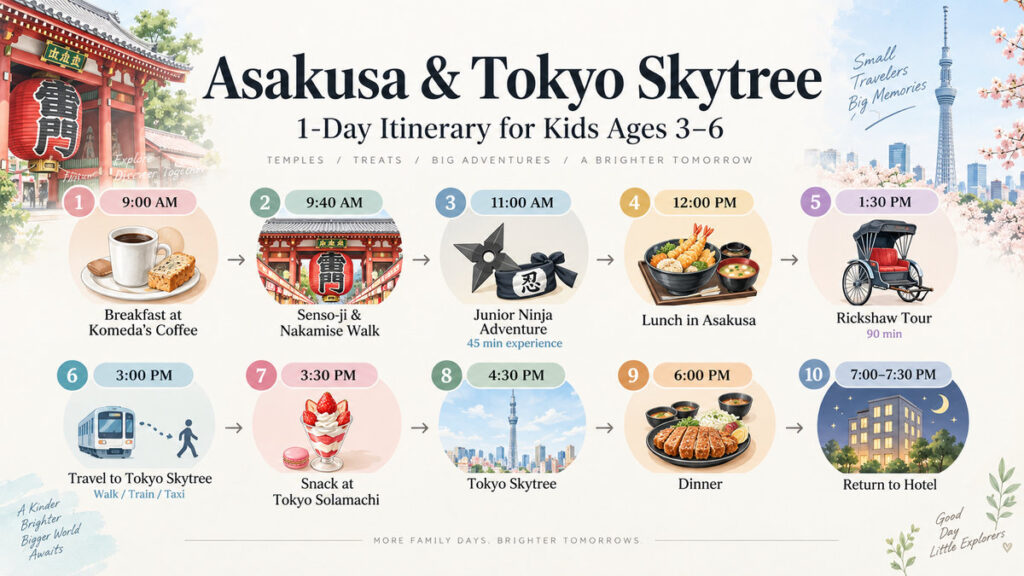
| Time | Plan |
|---|---|
| 9:00 AM | Breakfast at Komeda’s Coffee Asakusa ROX |
| Around 9:40 AM | Walk around Senso-ji Temple and Nakamise |
| 11:00 AM | Junior Ninja Adventure Experience |
| 12:00 PM | Lunch |
| 1:30 PM | 90-minute rickshaw tour |
| 3:00 PM | Travel to Tokyo Skytree |
| 3:30 PM | Snack break at Tokyo Solamachi |
| 4:30 PM | Tokyo Skytree observation deck |
| Around 5:30 PM | Explore Tokyo Solamachi |
| 6:00 PM | Dinner |
| Around 7:00–7:30 PM | Return to your hotel |
9:00 AM – Breakfast at Komeda’s Coffee Asakusa ROX
Start the day at Komeda’s Coffee inside Asakusa ROX.
When traveling with young children, starting with a proper sit-down breakfast can make the rest of the day much easier.
Asakusa ROX has restrooms, diaper-changing facilities, and free Wi-Fi, making it a convenient place to get organized before sightseeing.
This is a good time to:
- Check your reservations for the day
- Take children to the restroom
- Organize bags and strollers
- Make sure everyone has drinks and anything they need
There is no need to rush straight into sightseeing.
A calm start often makes a big difference when traveling with preschoolers.
Around 9:40 AM – Explore Senso-ji Temple and Nakamise Street
After breakfast, head toward Senso-ji Temple.
The classic route starts at Kaminarimon Gate, continues through Nakamise shopping street, and ends at the temple.
With children ages 3 to 6, I recommend keeping this part of the day to around one hour.
There are plenty of shops and snacks along Nakamise, but because lunch is coming soon, it is probably better not to stop for too much food.
You can walk around:
- Kaminarimon Gate
- Nakamise Street
- Senso-ji Temple
- The five-story pagoda
- The area around Asakusa Shrine
Because the ninja experience starts at 11:00 AM, try to finish sightseeing around 10:40 or 10:45 and start heading to the meeting point.
11:00 AM – Junior Ninja Adventure Experience
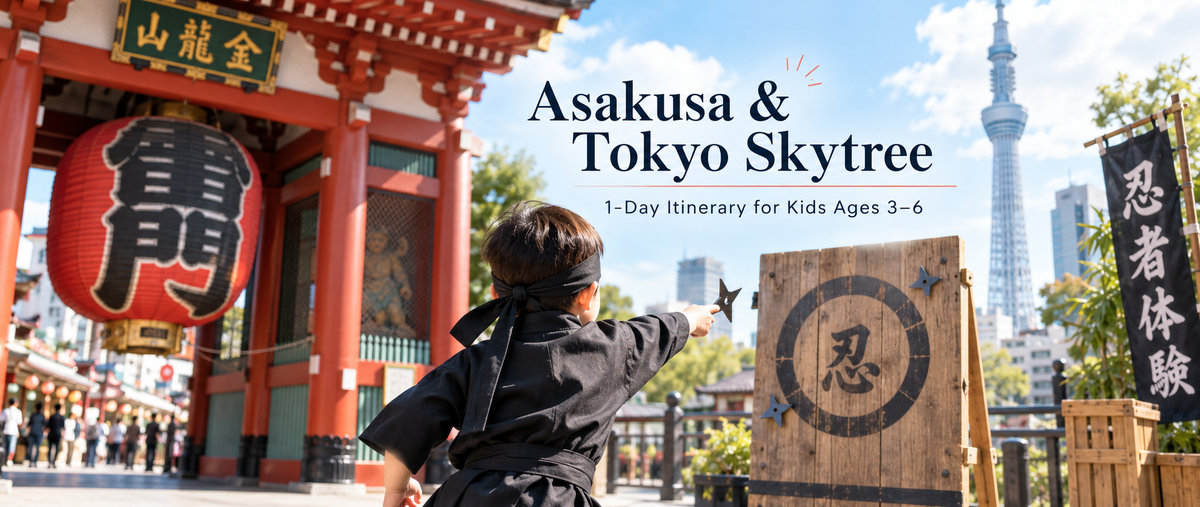
One of the best ways to make Asakusa more fun for young children is to add a ninja experience.
After spending the morning looking at temples and traditional streets, children can finally do something active themselves.
The experience takes about 45 minutes and includes child-friendly ninja activities such as throwing shuriken and learning simple ninja techniques.
Book in Advance with Klook
The Junior Ninja Adventure Experience can be booked through Klook.
For this itinerary, an 11:00 AM reservation works especially well because it fits neatly between morning sightseeing and lunch.
The timing looks like this:
11:00–11:45 AM – Ninja experience
↓
12:00 PM – Lunch
Booking ahead also makes the rest of the day much easier to plan.
12:00 PM – Lunch in Asakusa
Asakusa has plenty of great Japanese food, but when you are traveling with a 3- to 6-year-old, the food itself is only part of the decision.
It is also worth thinking about:
- How spacious the restaurant is
- Whether there are floor-seating options
- Whether a stroller is easy to manage
- Whether an English menu is available
- How long the meal is likely to take
Here are three different options depending on what your family wants.
Option 1: Onigiri Asakusa Yadoroku
Best for families who want a simple and very Japanese food experience.
Asakusa Yadoroku is known as Tokyo’s oldest onigiri specialty shop.
You can enjoy freshly prepared rice balls made right in front of you, which makes it a fun and easy Japanese food experience.
An English menu is available.
Good to know
The restaurant is very small, so it is not ideal for strollers.
Payment is cash only.
Because the shop can become busy, this option is best for families who have some flexibility before the 1:30 PM rickshaw reservation.
If there is a long wait, another lunch option may work better for this particular itinerary.
Option 2: Aoi Marushin
Best for families who prioritize comfort and space.
Aoi Marushin is a long-established tempura restaurant in Asakusa.
It has a large number of seats, including traditional tatami-style seating, which can make it easier to visit with children.
An English menu is also available.
This is a good option if you want to try tempura or tendon in a restaurant that feels less cramped than some of Asakusa’s smaller traditional restaurants.
Option 3: Asakusa Mugitoro
Best for families who want a more relaxed Japanese meal.
Asakusa Mugitoro specializes in Japanese dishes featuring grated yam and other traditional ingredients.
The restaurant is spacious and has an English menu.
It offers a different type of Japanese food experience from tempura or onigiri.
For this itinerary, however, it is best to choose a quicker meal rather than a long multi-course option, since the rickshaw tour starts at 1:30 PM.
1:30 PM – 90-Minute Rickshaw Tour
After lunch, it is time for a rickshaw tour of Asakusa.
This is especially well placed in the afternoon because children have already spent much of the morning walking.
A 90-minute rickshaw ride gives everyone a chance to sit down while still continuing to sightsee.
Depending on the tour, you may see areas such as:
- Traditional Asakusa streets
- The Sumida River area
- Views of Tokyo Skytree
- Historic neighborhoods around Asakusa
For children, simply riding in a rickshaw can be one of the most memorable parts of the day.
Rickshaw Tours Are Also Available on Klook
Rickshaw tours in Asakusa can also be booked through Klook.
If you want to follow this itinerary closely, booking a 1:30 PM slot in advance is a good idea.
That way, your three main reservations can all fit into a clear schedule:
- 11:00 AM – Ninja experience
- 1:30 PM – Rickshaw tour
- 4:30 PM – Tokyo Skytree
Traveling with Young Children
Rickshaw seating rules for young children can vary depending on age and how many people are riding.
If your child is around age 6, it is especially important to check the seating rules when booking, as this may affect how many rickshaws your family needs.
3:00 PM – Travel from Asakusa to Tokyo Skytree
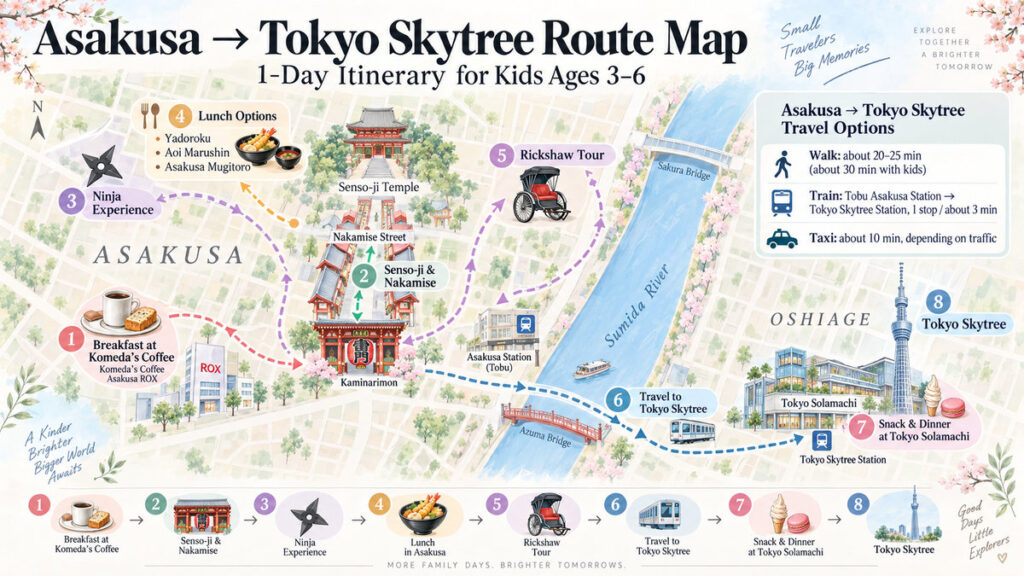
After the rickshaw tour, head to Tokyo Skytree.
There are three practical ways to get there.
Option 1: Walk
For adults, the walk takes around 20 to 25 minutes.
With young children, I would allow closer to 30 minutes.
If the weather is good and your child still has energy, walking can be a nice way to enjoy the riverside scenery and see Tokyo Skytree getting closer as you go.
Best for
- Children who are still energetic
- Good weather
- Families using a stroller
- Travelers who enjoy walking and city views
Option 2: Train
Take the Tobu Line from Asakusa Station to Tokyo Skytree Station.
It is only one stop, and the ride itself takes just a few minutes.
This is the easiest choice if you want to save your child’s energy.
Option 3: Taxi
A taxi is the most comfortable option.
Depending on traffic, the ride usually takes around 10 minutes.
If your child looks tired or sleepy after the rickshaw tour, taking a taxi can be worth it.
You do not have to use trains for every short journey in Tokyo.
A quick taxi ride can sometimes make the whole day much easier with young children.
3:30 PM – Snack Break at Tokyo Solamachi
Once you arrive at Tokyo Skytree, do not rush straight to the observation deck.
Take a short break first.
By this point, everyone has been out since the morning, so a snack and restroom break can help reset the day before the final sightseeing activity.
Tokyo Solamachi has several easy options around the food court area.
Option 1: Banana Biyori
A good choice for families who want something sweet.
Banana-based desserts are easy for many children to enjoy, and the chocolate banana is a fun option.
Option 2: Okhotsk Okoppe Milk Stand
A good choice if your child loves soft serve.
The milk-based desserts are popular, and the strawberry soft serve is especially nice for an afternoon treat.
Option 3: Tsukiji Gindaco
If your family wants something savory instead of sweet, try Gindaco.
It is one of Japan’s best-known takoyaki chains and a convenient way to try takoyaki without committing to a full meal.
4:30 PM – Go Up Tokyo Skytree
After your snack break, head up Tokyo Skytree.
Depending on the season, a late-afternoon visit may let you see the city in daylight and then watch the view change toward sunset.
Booking Ahead Is Recommended
Tokyo Skytree tickets can also be purchased through Klook.
With young children, avoiding long ticket lines can make the experience much easier, so booking a timed entry in advance is a good idea.
The 350-Meter Deck May Be Enough
Tokyo Skytree also has a higher observation area, but with children ages 3 to 6, the main 350-meter observation deck may already be more than enough.
If your child is still excited and energetic, you can continue higher.
If everyone is getting tired, there is no need to force it.
For a preschooler, 350 meters is already very, very high.
Around 5:30 PM – Explore Tokyo Solamachi
After coming down from Tokyo Skytree, spend a little time looking around Tokyo Solamachi.
There are plenty of shops, but by this point in the day, your child may be getting tired.
There is no need to walk through every floor just because you are already there.
If your child is ready for dinner, skip the shopping and head straight to the restaurant.
6:00 PM – Dinner
For dinner, it helps to have both a special option and an easy backup plan.
Option 1: Matenro
Best for families who want a special dinner with a view.
Matenro is a restaurant where you can enjoy both dinner and impressive views around Tokyo Skytree.
Foreign-language menus are available, and the restaurant offers family-friendly features such as children’s meals and high chairs.
Strollers are also welcome.
Reservations are available, so booking ahead is recommended if this is an important part of your day.
Option 2: Brasserie Aux Amis
Best if your family wants a break from Japanese food.
After several days in Japan, some families are simply ready for something different.
Brasserie Aux Amis serves French food and also offers impressive views.
Children’s menus and high chairs are available, and foreign-language menus are offered.
Reservations are possible, so booking in advance is a good idea.
Option 3: The Food Court
Best when your child is completely done for the day.
After a full day of sightseeing, 6:00 PM can be the point when a preschooler has simply had enough.
In that situation, do not force a long restaurant dinner.
The food court is an excellent backup.
You can find easy options such as:
- Udon
- Ramen
- Chicken dishes
- Takoyaki
There is also a Tomica shop nearby.
If your child is getting bored while waiting for food, looking at toy cars or buying a small Tomica car to play with can be a useful distraction.
When traveling with young children, finishing the day happily is more important than sticking to the original restaurant plan.
Around 7:00–7:30 PM – Return to Your Hotel
After dinner, head back to your hotel.
If you have been out since 9:00 AM with a 3- to 6-year-old, this is already a very full day.
Once you return, keep the evening simple:
- Bath
- Get ready for the next day
- A little quiet play
- Bedtime
It can be tempting to keep sightseeing because you are in Tokyo, but returning to the hotel at a reasonable time usually makes the next day much more enjoyable.
Why This Itinerary Works Well for Kids Ages 3–6
The biggest advantage of this itinerary is that it does not repeat the same type of activity all day.
The rhythm looks like this:
See
Senso-ji and Nakamise
↓
Do
Ninja experience
↓
Eat
Lunch in Asakusa
↓
Sit and sightseeing at the same time
Rickshaw tour
↓
Travel
↓
Rest and snack
↓
See something exciting
Tokyo Skytree
That change of pace is important for preschoolers.
Young children often get bored when they spend hours simply following adults around famous sightseeing spots.
Adding hands-on activities, food, rides, and breaks makes it much easier for them to stay engaged.
What Should You Book in Advance?
If you want to follow this itinerary closely, I recommend booking these three activities before your trip:
- 11:00 AM – Junior Ninja Adventure Experience
- 1:30 PM – 90-minute Asakusa rickshaw tour
- 4:30 PM – Tokyo Skytree
All three can be booked through Klook, which makes it easy to organize the key parts of the day before you arrive in Tokyo.
Final Thoughts: Make Asakusa Fun for the Kids Too
Asakusa is fascinating for adults, but temples and traditional streets alone may not hold a preschooler’s attention for an entire day.
That is why this itinerary adds experiences that children can enjoy for themselves.
Become a ninja.
Ride in a rickshaw.
Have a snack.
Look down at Tokyo from one of its tallest landmarks.
And if you do not follow the entire itinerary exactly, that is completely fine.
If your child is tired, take a taxi instead of walking.
If dinner at a restaurant feels too difficult, use the food court.
If everyone has had enough, skip shopping at Tokyo Solamachi.
Traveling with young children is easier when the itinerary has room to change.
You do not need to visit the maximum number of attractions to have a successful day.
If everyone can return to the hotel thinking, “That was fun,” it was a good day in Tokyo.